#crosspollination
  • Blog
  • Who We Are
  • Get In Touch
  • Blog
  • Who We Are
  • Get In Touch

Cross-Pollination

Growing cross-sector design collaboration in placemaking

Initial reflections on cross-pollination in Merthyr Tydfil

4/26/2022

 
The cross-pollination programme in Merthyr Tydfil builds on work that members of the team have supported as part of a pre-existing Creative Industries Training Programme, funded under the UK Community Renewal Fund (CRF). The CITP CRF programme aims to support and build capacity in the creative industries in Merthyr and incorporates a number of different partners contributing in different ways to help develop skills, raise aspiration and confidence in the local community, and inspire learning. Connected through the Open University’s Partnerships team operating in Wales, OU researchers (Katerina Alexiou, Theo Zamenopoulos and Nic Lotz) offered to help develop and deliver a small part of this larger programme, which is focussed on bringing different local actors together to co-design a plan for creative activities that will benefit members of the community.
 
The cross-pollination project will complement and add to this work, with a broader focus on community-led design and placemaking, and a more strategic goal of supporting collaboration between different organisations/sectors to grow in the future.
 
In this blog post, we discuss how the cross-pollination approach has been used so far as part of the CITP CRF programme and offer some initial observations and reflections to bear on our cross-pollination journey.
 
Co-Design Workshop #1
This first workshop brought together 10 people representing different organisations in Merthyr (Merthyr Tydfill Borough Council, Merthyr Valley Homes, Merthyr Tydfill Housing Association, Voluntary Action Merthryr Tyffill, University Health Board) as well as members of the Open University in Wales, to begin sharing their work and interests and explore ideas for collaboration.
 
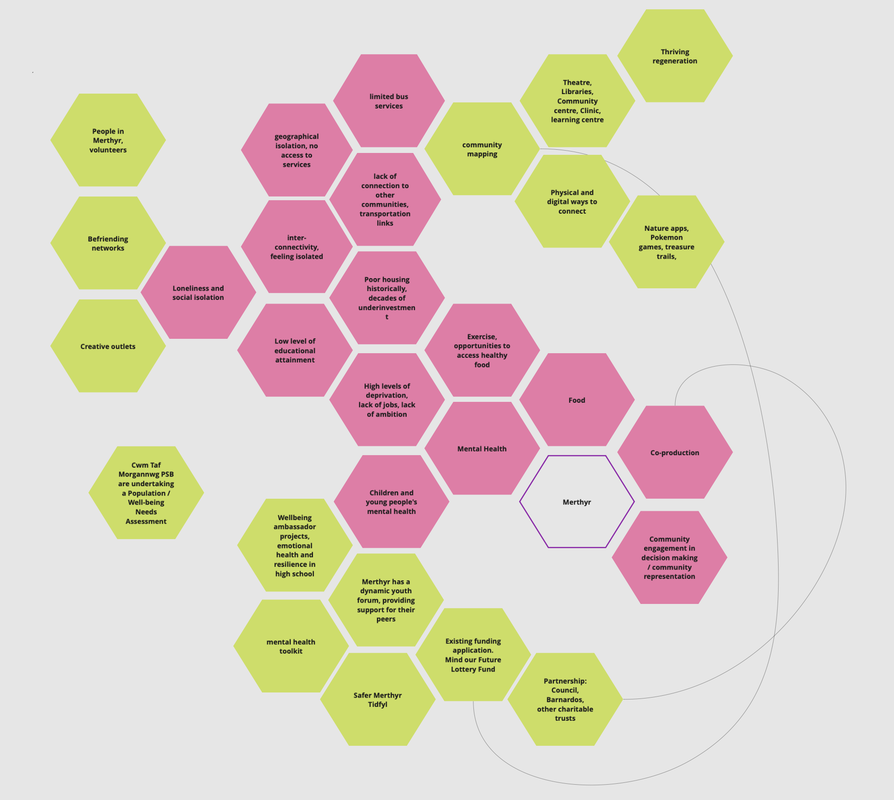
We used a Miro board to record contributions and share information about existing projects. After a short introductory sharing session, participants worked in groups to focus on mapping challenges they perceive as important in Merthyr but also assets, existing resources (projects, people, experiences) that they consider important.
 
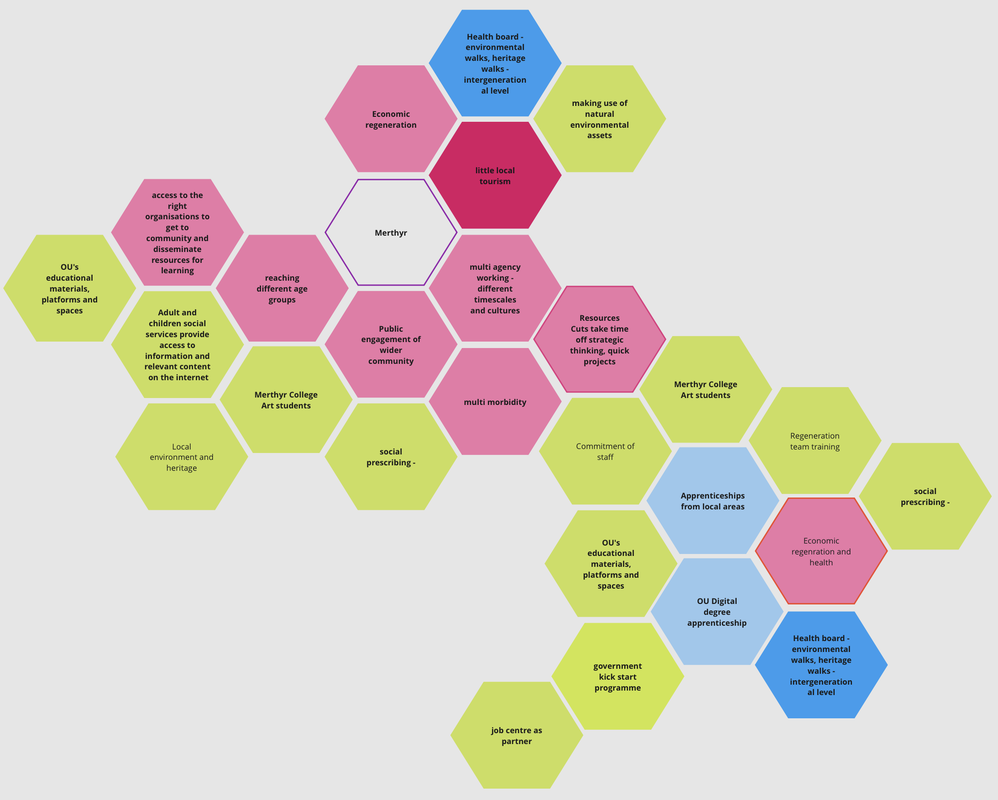
Participants indeed identified a number of matters of concern or challenges that they thought need to be the focus of their work in Merthyr. These referred mainly to two broad categories: high levels of deprivation across multiple dimensions and limited levels of engagement, communication and connection between communities and decision-makers. Here is a list of bullet points:
 
​High levels of deprivation at multiple fronts
  • Economy: challenges in instigating economic regeneration
  • Education: low level educational attainment
  • Employment: lack of jobs and lack of ambition
  • Health and wellbeing: lack of opportunities to access healthy food, mental health problems, social isolation
  • Housing: lack of good quality housing and increased homelessness 
  • Access to services:  lack of transportation links, access to support organisations
 
Limited levels of engagement, communication and connection between members of the community and with decision making processes.
  • challenges in reaching and engaging different age groups
  • challenges in access to the right organisations for connecting with different communities and disseminating learning
  • challenges in collaboration that arise with different timescales and cultures
  • lack of community representation and engagement in decision making
 
On the other hand, counteracting these challenges, participants pointed to a variety of assets that can be catalyst for a positive change in Merthyr, such as community facilities, existing regeneration programmes and expertise, strong partnership links and existing networks of volunteers. Here is a list of bullet points:
 
  • Available team training for economic regeneration
  • Building on the government’s kick start program
  • Access to OU educational platforms
  • Existing programmes/funding in the area of health and wellbeing
  • Partnership links with schools, charitable trusts etc
  • Volunteers
  • Community facilities (theatre, libraries, learning centre etc)
  • Existing community mapping programme
  • Commitment of staff in the local council and housing associations to engage and support community engagement
  • Connections with Merthyr College art students
 
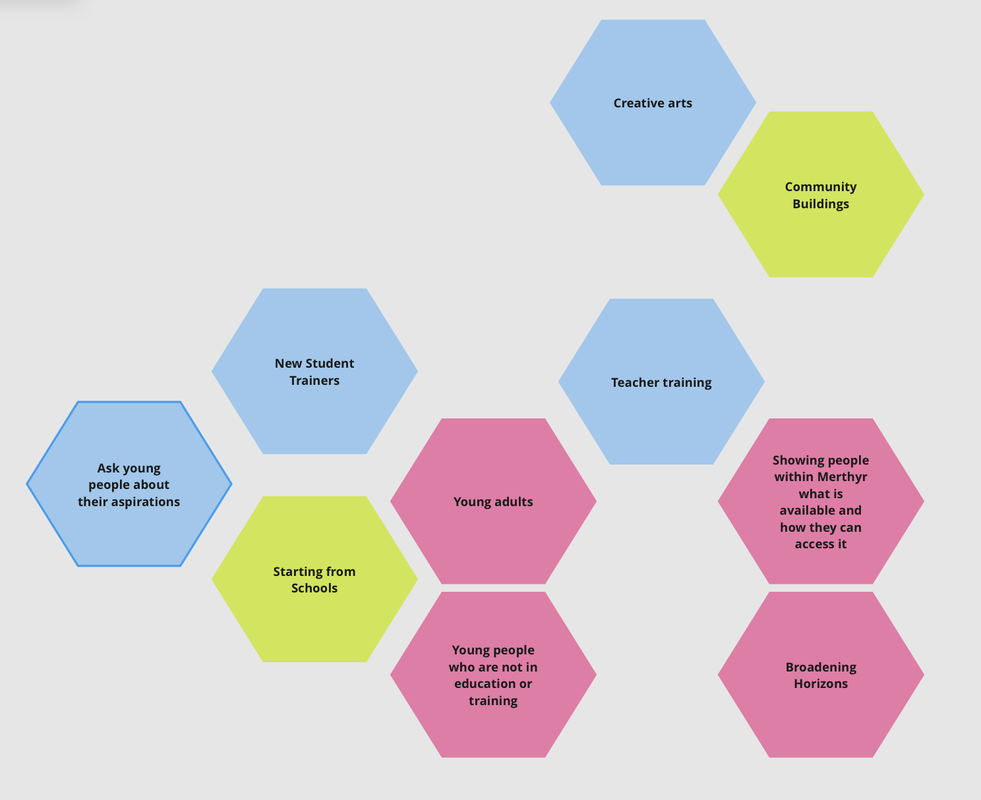
Moving on from challenges and assets, participants also started exploring opportunities, i.e. ideas about things (actions, events etc) that could help address the identified challenges using the assets available and some initial ideas started forming around collaboration with schools and young people and apprenticeships, all underlined by creative activities, arts, games etc.
Figure 1. Screenshots from the Miro board. Pink hexagons represent challenges, green represent assets and blue represent opportunities
Overall, the workshop helped painted a picture of Merthyr as a place that faces socio-economic challenges and deprivation at multiple fronts (education, employment, housing, health and wellbeing), but that also has many historical and emerging assets that can support regeneration efforts. The limited available to the group to reflect on their place, their challenges and their aspirations (limited also by the online format) meant that we did not go very far into generating workable ideas for collaboration.
 
Co-Design Workshop #2
As a next step, the team organised a second co-design workshop in order to focus more on ideas and steps to address a particular challenge, using the creative industries to do so. To help focus the discussion, it was suggested to concentrate on housing, but participants were encouraged to suggest ideas around other topics of interest.
 
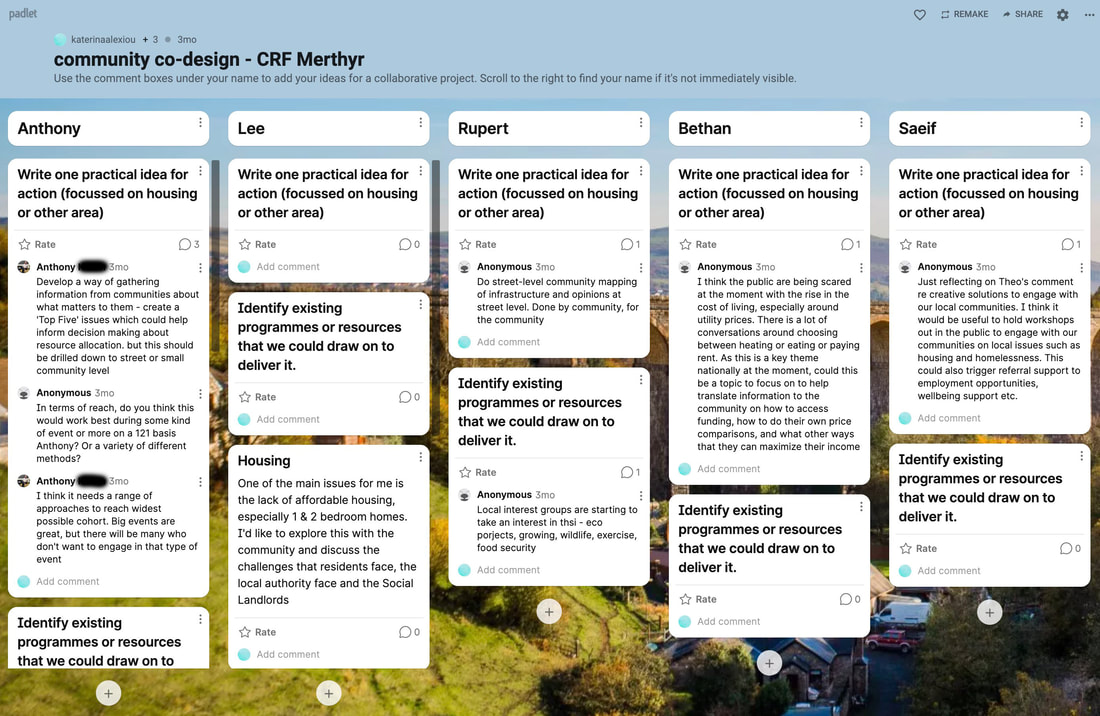
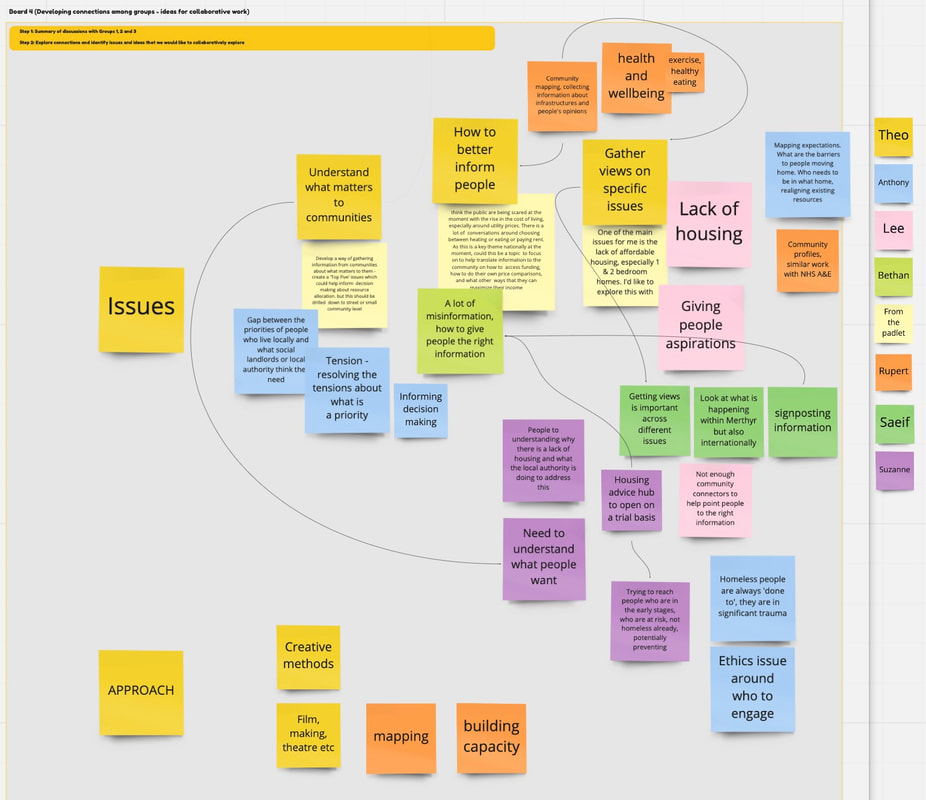
For this workshop, we used a Padlet which invited participants to contribute ideas in advance. They were asked to a) contribute at least one practical idea for action and b) identify existing (past or completed) programmes or resources that we could draw on to deliver it. 7 participants joined the online workshop. We first continued working on the Padlet, discussing individual ideas and then worked to identify shared areas of interest and generate ideas for collaborative action. The second part of the workshop was recorded using Miro.
Figure 2. Screenshots from the Padlet and Miro board used to generate and develop ideas.
Participants chose to focus on the topic of lack of housing and lack of informed decision making around housing. A natural point of connection emerged around the idea that new practices need to be developed, in order to help decision makers (council, housing associations, and related authorities) better understand what is happening on the ground (what matters to local residents and what their experiences and priorities are), but also how decision makers can share useful information and advice more effectively to help prevent homelessness. From this process the idea started forming for the delivery of an open-day event in one of the local housing areas in the Gurnos ward, inviting local residents to engage in creative activities in order to share their views and aspirations for their place.
 
At the moment, the focus of the CRF project is to organise an in-person Design Day in Merthyr, to bring key players together to explore the area and the facilities available and to make a plan for the Open Day. The Cross-pollination project will seek to explore how value can be added to this activity going forward and how learning and practices developed through the CRF project can be scaled up.
 
Reflections
One interesting observation and parameter to take into consideration is that the CRF project has so far been organised remotely. Despite the fact that Covid restrictions have been gradually lifting since the application was first put in, it has been difficult to predict and plan around people’s availability. Face-to-face activities were stalled, and online workshops seemed to have less traction as people suffered from meeting fatigue and had limited time to dedicate.
 
Local elections also created an unexpected challenge. Local councillors were reluctant to engage in the period running up to elections, not (only) because of lack of time, but also because of a moral need to dissociate community engagement work from campaigning. The election outcomes may also affect people’s role in the project and potentially their ability to continue their involvement.
 
Despite all these challenges and uncertainties however, our experience in Merthyr showed us that there is a significant need but also a significant and sincere appetite for people across sectors and industries to work together and with their local communities, and to combine their skills and resources in order to affect positive change in their places. We anticipate very different ideas and working practices to emerge in the three places (Merthyr, Glasgow and London) but we hope this experience will help gain a broad understanding of the barriers and pitfalls but also the diverse and original ways in which they can be overcome to generate social, economic and cultural value and promote individual and community wellbeing.

Comments are closed.
Powered by Create your own unique website with customizable templates.